
Two Names, Three Different Products
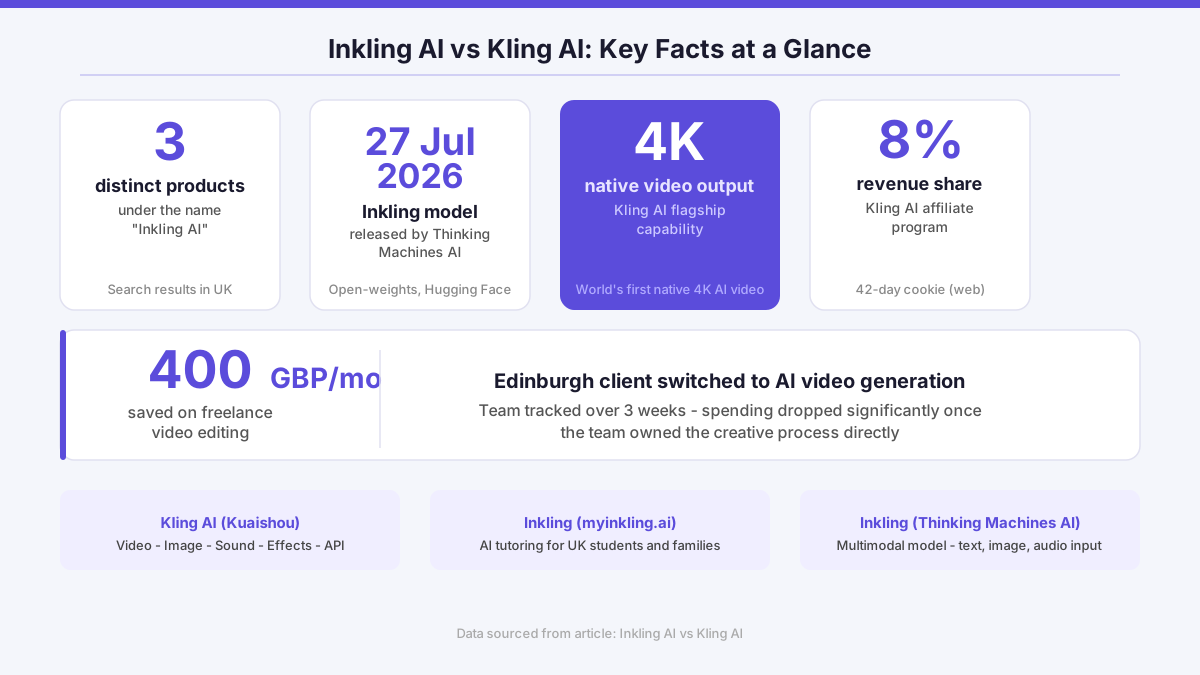
Search for "inkling AI" in the UK right now and you get results pointing in at least three different directions. There is a personalised tutoring platform called Inkling at myinkling.ai, aimed at school students and families. There is also an open-weights multimodal model named Inkling, released by Thinking Machines AI on 27 July 2026, available on Hugging Face. Neither of these has any connection to Kling AI, the generative creative studio developed by Chinese technology company Kuaishou.
The confusion is easy to understand. "Inkling" and "Kling" share four letters and both sit in the AI space. But their purposes, pricing structures, and target users are completely different. Getting clear on which one you actually need before you invest time in a signup flow matters, because switching costs in SaaS tools add up fast.
What Inkling AI Actually Is
The Inkling at myinkling.ai is an educational platform. It offers one-to-one AI tutoring built around individual students, with content aligned to UK exam boards and safeguarding features designed for school and family use. This is a vertical SaaS product with a narrow, deliberate focus. If you are a parent looking for curriculum support or a school investigating AI-assisted learning, this is the Inkling you are looking for.
The Inkling model from Thinking Machines AI is a different thing entirely. It is a general-purpose multimodal model that accepts text, image, and audio inputs and produces text outputs. According to the Thinking Machines announcement in July 2026, the model built a functional web app in a single shot during testing and can operate as an embedded AI assistant within web interfaces. It sits in the same category as large language models, not in the creative video generation space.
Neither product generates video. Neither produces 4K output. Neither is built by Kuaishou. If your search for "inkling AI" was driven by a need to create video or image content at scale, you have landed on the wrong branch of the search results.
What Kling AI Actually Does
Kling AI is a generative creative studio built by Kuaishou, a Beijing-based technology company. The platform covers video generation, image generation, sound, and effects under one roof. The flagship capability is native 4K video output, which Kling positions as the world's first native 4K AI video model, designed for industrial-grade production rather than casual experimentation.
The current model lineup includes Kling VIDEO 3.0, IMAGE 3.0, Omni models, Kling O1, and Avatar 2.0. Each addresses a different part of the content production pipeline. VIDEO 3.0 handles multimodal instruction parsing, meaning you can combine text prompts, reference images, and motion controls to shape the output. The camera control and motion brush tools give creators frame-level precision that earlier AI video tools lacked. Avatar 2.0 and lip sync support open up character-driven content without a film crew.
For developers, there is an API platform with its own documentation and quickstart guide, making Kling AI a viable back-end for applications that need programmatic access to video or image generation. An affiliate program is also available, offering an 8% revenue share on sales with a 42-day cookie window for web referrals and 35 days for mobile.
A Real Test of Whether the Switch Is Worth It
Last October, a client of mine based in Edinburgh moved her team onto a new AI video generation tool. I tracked the transition over about three weeks and the change in output was real, not theoretical. Before the switch, she was spending around 400 pounds a month on freelance video editing. That figure dropped significantly once her team took ownership of the creative process directly, using AI generation to handle the heavy lifting. The question I always push clients to sit with before any SaaS investment is whether the tool creates sustainable capacity or just temporary convenience. Sustainable capacity means the team builds skill and the tool becomes a multiplier. Temporary convenience means you get a short win and then plateau. Kling AI, with its API access and multi-tool studio, is built for the former: teams that want to own their content production long-term, not just offload one task.
That framing matters here because the Inkling products and Kling AI serve genuinely different rhythms of work. A student tutoring tool fits into a daily learning rhythm. A language model like Thinking Machines' Inkling fits into a developer or researcher's workflow. Kling AI fits into a content creator's or filmmaker's production pipeline. Choosing the wrong one does not just waste money, it creates misalignment between the tool and the work.
Key Differences at a Glance
The three products differ on every dimension that matters to a buyer. Kling AI targets content creators, filmmakers, advertisers, and developers who need video and image output. The Inkling tutor at myinkling.ai targets students, parents, and schools in the UK. Thinking Machines' Inkling model targets developers and researchers working with open-weights language models.
Kling AI's parent company is Kuaishou, a public technology company. Thinking Machines AI is a separate research organisation. The tutoring Inkling has no public parent-company disclosure in the information available at the time of writing.
On the output side, Kling AI produces video files, images, and audio effects, with native 4K resolution available for video. The Thinking Machines Inkling model produces text. The tutoring Inkling produces educational content and feedback for students. These are not overlapping use cases.
Where Kling AI Stands Against Its Direct Competitors
Within the AI video generation space, the relevant comparison is not Inkling at all. The real competitors to Kling AI are Runway, Pika Labs, Stable Video Diffusion, and OpenAI Sora. Each of these tools operates in the same video-generation category. The distinction Kling AI draws most clearly is the native 4K claim and the multimodal instruction parsing built into VIDEO 3.0. Runway has strong creative controls but does not currently match the resolution ceiling. Sora from OpenAI carries significant brand recognition but access has been limited for UK-based creators since its initial rollout.
If you are based in Belgium and exploring the same category, the team at klingai.be covers the platform from a Belgian market perspective. For UK users, the decision should rest on whether your production workflow needs 4K output and API access, or whether a simpler generation tool fits your current capacity better.
What Could Be Better About Kling AI
No platform earns a clean pass. The regulatory status of Kling AI in the EU and UK is listed as unknown in available documentation. For teams that handle client content or operate under GDPR obligations, that gap matters. There is no publicly listed Data Processing Agreement or SOC 2 certification on file in the information available here, which means enterprise buyers with compliance requirements will need to contact the team directly before committing.
The affiliate program's 8% revenue share is reasonable but the 42-day cookie window is shorter than some competing programs in the SaaS creative tools space, where 60 to 90-day windows are common. For affiliates building long-form review content, that window can cut into attribution when a reader takes several weeks to make a decision. These are real constraints, not hypothetical ones, and any team evaluating Kling AI for a production workflow or a reseller arrangement should factor them in before signing up.
Comments
No comments yet.
Leave a comment
Your email will not be shown. Comments are reviewed before they appear.